Thursday, May 24, 2007

MySQL gains popularity in both System i and Google.

Many heard the recent announcement by IBM that they are supporting the MySQL database on the System i (formerly AS/400), but the support is flowing in. Google has unveiled new enhancements, and while Google doesn't use MySQL in its search, it uses it in its vast YouTube network...and that is a powerful, data-heavy, file-heavy site.

My SQL, which started as a read-only database, caught on because of its ability to speedily serve Web pages. While MySQL hasn't displaced DB2 or Oracle as the two leading databases in production settings, among developers, a recent survey by Evans Data indicates the developer's database of choice for 40% of their responders. Read more here»

Tuesday, May 22, 2007

5 Best Practices for IT Cost Containment

With the recent emphasis on crossover between business acumen and IT, it's a good idea to keep an eye on your budget, and do what you can to keep your IT costs down. One good reason? With these ever-blurring lines, now, more than ever, IT has its best shot at re-investing those savings.

5 Best Practices for IT Cost Containment»

Monday, May 21, 2007

App Tip: Customize error messages in your Web applications

One of the most important benefits of m-Power is the ease with which you can create customized Web applications.

And that includes the wording of error messages, whether across the board, or for individual apps. (These are the messages your user sees if they enter data in the wrong field, or don't enter information in mandatory fields). See how easy it is»

Thursday, May 17, 2007

The Business-Savvy Smartphone Review: Going wireless

Many articles on smartphones cover the ins and outs of wireless devices for the average consumer, but here's an article that focuses on four of the top smartphones for business purposes, and why.


Here's a short case study about one manufacturer's wireless applications to give you some ideas.

Wednesday, May 16, 2007

£50,000 for a custom app vs £250,000 for a canned one.

Recently, a UK manufacturer in the market for an online shopping cart went to their packaged software vendor for what they hoped would be a "plug and play" solution. It certainly seemed like that would make the most sense. But, they found that with software, implementation, and training they would be spending £250,000, or around $440,000 US.

This staggering cost had them looking for alternative options. And, what they found was even more surprising. They could (and did) create a customized shopping cart like this one in much less time, for much less money.

The total price tag for all of their needs? £50,000. Just 1/5 the cost quoted for the canned solution.

Monday, May 14, 2007

Success: How one company faced down massive datamart challenge with Web-based BI

With 15 companies, representing 8 separate industries, flexible Web reporting was not only key, but crucial to keeping Bosselman Energy Company's employees informed, and able to do their jobs at top levels.

And, with more than 15 million records in their datamart and more than 600,000 records being added each month, Bosselman had an even bigger challenge on their hands. See how they rose to meet it»

Thursday, May 10, 2007

Web design Tip: Exploring the Hidden workings of m-Painter

When m-Power introduced its m-Painter features, we talked about the advantages it gives developers to create the look of their Web apps on the fly, and handed you the top 5 reasons to use it.

But...we may not have given you a breakdown of some of the features at your fingertips. Here's a quick overview of the toolbar features.

Thursday, May 03, 2007

Many IT shops are playing it too safe. Is yours?

According to this Information Week article, it's time to get back to innovation that drives business: "The numbers indicate that tech leaders need to snap their associates out of their comfort zones." They call it the ROI effect: "At times, companies put the kibosh on experimentation because they don't see the return on investment in it."

But, it's that type of experimentation that can often lead to greater payoffs, and even greater solutions. Take the case of this IT innovator»

Wednesday, May 02, 2007

SOA: Hype versus reality

Is 2007 the year of SOA? Apart from the sheer technical complexity, full-scale deployment of SOA requires deep interdepartmental shifts. No wonder it’s slow going.

“The IT side has to understand the business side – finally. They need to understand what the requirements are so that the IT department can create these applications and services to really support the business.” Read more»>

Of course, it also helps when the technical complexity gets simplified. Let us know how m-Power can help your SOA project.

Thursday, April 26, 2007

BI tools to integrate existing apps and ease-of-use

According to a recent Information Week survey, nearly 80% of respondents are interested in the ability to integrate BI offerings with existing applications. And, it's not only possible...but click your heels and, well...see below.

This company created a powerful custom Business Intelligence Web dashboard that works with their existing systems...and they were able to create it in-house in a matter of days. Here's how»

Wednesday, April 25, 2007

Four steps to CIO relevance

Here's an interesting (and short) article from InformationWeek outlining the four steps to staying relevant as a CIO: Streamline, Offload, Reinvest, Innovate.

Get the steps»

Monday, April 23, 2007

Application Tip: How to go wireless with your Web applications

Wireless applications continue to make their case for improving employee productivity and saving gobs of money.

So...what if you could create them almost instantly and offer them to your business leaders at no additional cost and could single-handedly save your company big money?

The only thing you need to do to deploy your m-Powered applications as wireless, is to tweak the presentation layers of your application differently to make it useful to the wireless user. Here's how»

Friday, April 20, 2007

Earth Day 2007: 10 steps to a green Data Center

As most CIOs know, data centers often require a ton of electricity to maintain, and some vendors are starting to feel the CIOs' pain, marketing their servers and processors as energy efficient and eco-friendly.

So, recently, CIO Insight sat down with Dave Douglas, the vice president of eco-responsibility at Sun Microsystems, to craft some ways to cut energy costs from the data center and do the earth a favor in the meantime.

In honor of Earth Day (April 22), here are 10 steps to a green data center»

Wednesday, April 18, 2007

2 powerful IT conferences march into April and May education events

We're on the move this month to some powerful new educational seminars. If any of these are in your neck of the woods, come by and see us!

COMMON is just around the corner April 29-May 2, hosted in Anaheim, CA (Booth 401). And we'll be hosting a hands-on lab.

We'll also be at the Friedman User Group Conference in Las Vegas, Nevada May 14-16, and we'll be presenting on building successful Web initiatives in the B2B market space.

Check out more information on these events here»

Monday, April 16, 2007

Web Design Tip: Take your users where you want them to go.

There are many reasons you may want to create a Web page that redirects your users to a different part of your site. It could be a cumbersome URL, a Web page that was removed, or reserving the right to make changes to an application's URL.

Here's a quick how-to article to that tells you...well, how to create an HTML redirect or jump page.

Friday, April 13, 2007

Six Tips to Make IT projects and new ideas Succeed

Helping your ideas gain traction in the boardroom (and in practice) can be a tricky business. A new book offers CIOs some best practices. Here's an excerpt»

Wednesday, April 11, 2007

Forget the Chart, Check the Cell Phone

Blue Cross of Northeastern Pennsylvania is betting you'll want your health data, especially if you're getting emergency treatment while traveling.

Starting at the end of March, they are providing 100,000 of its members with electronic access to their and their dependents' personal health records. Members will be able to access their information from cell phones as well as PDAs and PCs.

Read how this will work»

If you're interested in creating a similar application, to run on a wireless phone, you can learn more about m-Power's wireless capabilities here.

Friday, April 06, 2007

Developers: Expect a new language in the next five years

According to software experts attending the The ServerSide Java Symposium, IT should expect an entirely new language in the next five years, and an ongoing adaptation of current languages such as XML and Java. Read more about it here»

But, m-Power users don't have to worry about that because m-Power insulates users from the constant changes in languages, and gives them the ability to constantly adapt to the changing times. It lets you focus on what you want to build, not HOW to build it. Test your skills here»

It just takes 15 minutes to create one applications, and thirty minutes for two.

Wednesday, April 04, 2007

Three major factors failing RFID

There are three major factors that are causing RFID programs to fail according to Sara Lee CIO, which one is most harmful to your program?

Wednesday, March 28, 2007

Integration as Cure: the future of Medical Records

Electronic Medical Records or EMRs faces its fair share of challenges, but the demand for them is growing. Electronic health records could improve care, reduce errors and eventually lower healthcare costs, but obstacles abound.

One of the biggest? Most hospitals and doctor's offices use noninteroperable software and databases. And, there are some other obstacles such as privacy and cost.

Here are some ideas on ways around these»

Monday, March 26, 2007

Dear Marcy, Why would anyone want to copy and paste Excel data?

Dear Marcy,
I get weekly sales data sent to me via csv files, and then I use pivot tables in Excel to analyze the information and create reports based on that information, and e-mail it to my colleagues. That way I don’t have to get IT involved, and they don’t have me messing around on the database.

I saw last week that Joe was talking about Excel spreadsheets on his blog, and how end-users could copy and paste data from Excel into m-Power, but I went through the presentation, and I don’t really understand why a company would want to do this?

Here's what Marcy had to say»

Friday, March 23, 2007

IT Productivity: Measuring the Immeasurable

Raw productivity gains, according to this article, aren't sufficient to compete successfully in the 21st century. "What you want is agile productivity," he maintains. "You want to be able to repurpose the assets of your business as efficiently as possible to stay current with the market."

Agility, of course, is but another way to describe a kind of perpetual state of innovation, of moving fast enough—through product and process development, and into and out of markets as opportunity dictates—to compete.

Thursday, March 22, 2007

Poolside business apps and other (better) ways to do business.

When Emhart Glass's Application Development Manager, Alan Batchelor, had to interrupt his vacation and go into the office because one of his servers was not started, he was pretty annoyed. And rightly so.

Necessity is the mother of invention, though.

Alan solved the problem, quite ingeniously, by creating a wireless application with m-Power that allows him to send commands from his cell phone even when he's poolside. And that was just he beginning. Learn what else he built»

Friday, March 16, 2007

New Coalition Giving U.S. Doctors Free E-Prescribing Software Services

It's estimated that 3.2 billion prescriptions are written each year by U.S. doctors, and currently less than 20% of American doctors use e-prescribing, says Dr. Nancy Dickey, currently president of the Health Science Center and vice chancellor for Health Affairs at the Texas A&M University System and formerly president of the American Medical Association.

It's also estimated that between 7,000-9,000 American patients die -- and 1.5 million are injured -- each year by preventable medication errors, according to a July 2006 report by the Institute of Medicine.

Read all about it»

Wednesday, March 14, 2007

Study: Leading retail sites slow to adopt AJAX

According to a recent survey less than 20 percent of retail shopping sites are using AJAX to build out their sites, and only 6 percent are using advanced AJAX techniques.

"AJAX is arguably the best rich Internet application available to developers right now, but its complexity and the disruption to traditional development processes (seem) to be hindering the widespread adoption predicted by many experts," says one of the study administrators.

Particularly in companies where product information can be called up (like retail) or manufacturing, distribution, so users can immediately get all of the information they need instantly. Of course, this isn't as big of an issue when AJAX is built right in.

Wednesday, March 07, 2007

Cool new technology: Think cows with tattoos

Just when you thought you've heard of everything...picture cows with tattoos. A new technology has been developed: a safe, invisible, RFID ink that can be detected up to four feet away.

While the jury is still out on the big brother implications of this breakthrough, the possible uses of this ink seem boundless. The FDA and CDC will be able to track food from beginning to end to quickly track down such problems as e.coli outbreaks and animal diseases.

Stolen goods can be quickly ID'd and returned. And in the supply chain community, this may mean an even more seamless method of tracking goods and packages from creation to sale, and everything in between. Learn more here»

Thursday, March 01, 2007

Trend to watch: How IT Is Revitalizing Staff Skills

This ComputerWorld article offers insight as to where IT is leading, and keeping staffers focused on the best ways of applying technology to business, rather than focusing on technology skills in and of themselves.

“You can go on the street and find a good Java programmer or those types of skills,” says William Ulrich, president of Tactical Strategy Group Inc. in Soquel, Calif. “It is much more difficult to go outside the company and find someone who understands the in-depth nature of your business.”

Here's what skills are being valued»

Friday, February 23, 2007

Web 2.0 transcends hype for business

You may not be ready to embrace concepts like "social computing" or "participative computing" in your organization, but the benefits of Web 2.0 can no longer be ignored. In fact, Web 2.0 figures prominently in Gartner's latest list of key actions IT leaders should take over the next three years to demonstrate value to their organizations. This article from 1105 Media gives you the 411. Read more»

Thursday, February 22, 2007

Trend to watch: Manufacturing Job One: Improve information flow.

In a recent article published by Intelligent Enterprise on the Top Seven Trends to watch, one to focus on is found in Manufacturing's inherent need to improve information flow.

Manufacturing executives realize that if they can solve the problem of gathering information from their company's portfolio of data sources in the plant or value chain--and build that capability into a linked enterprise process--they will have a considerable competitive advantage. Here are some examples of what we mean»

Monday, February 19, 2007

Magically turn Excel pivot tables into Web reports.

Every day end-users across the globe spend a large amount of time pulling data into spreadsheet programs like Excel, and then using pivot tables and the like to analyze data. This wastes a lot of time, is insecure, inefficient, and often inaccurate.

But, there's a new way you can help your end-users save time, do away with security issues, AND create their own Web reports. Here's a short presentation on how»

Wednesday, February 14, 2007

What SaaS (Software as a Service) means for you

What is SaaS? Here's the simplest way to think of it: "The Web has become a solid application delivery platform, transforming the way we can deploy enterprise software." This CIO Magazine article gives you a better picture, AND names it as one of the top 5 major IT changes that you need to consider.

Whatever you choose to call it, it all amounts to becoming more flexible and nimble and saving money by not having to write code from the ground up for each application. Here's one manufacturer's story on how they created an enterprise-level executive dashboard tied to their enterprise software package...without having to write it from scratch.

Monday, February 12, 2007

Calling all System i Innovators

Individuals and organizations that have discovered innovative ways to utilize their System i platform are in luck.

Now is the time to nominate someone—perhaps yourself--perhaps your favorite Tool Vendor (hint, hint)—for one of the IBM System i Innovation Awards. The nomination deadline for the 2007 awards is end of day on Wednesday, February 28, 2007.

You've worked hard on your system designs, and development. Start reaping the rewards!

Check out the details here»

Friday, February 09, 2007

Dear Marcy, What's the deal with AJAX?

Dear Marcy,

I keep hearing about AJAX, but I don't really have a grasp on what it's all about, or why it would be helpful for a company like mine? (We're strictly B2B.) Could you give me a basic understanding in a nutshell, of why I should be interested in it?

--Curious in Canada


Here's her response»

Thursday, February 08, 2007

Trend to watch: Business Analysts Step Up and Design for Agility

There are new factors changing not only Business/IT alignment, but also the role of the business analyst. This shift puts the business analyst in the role of application planning, and design in many cases--without any specific IT implementation required of them.

This renewed focus on "What is Needed" rather than "How it is built" is a paradigm shift similar to the IT equivalent of what manufacturers did to enable themselves to construct product simulations before ever cutting a single piece of material.

Here's a quick article that takes a look at the ins and outs of the Business Analysts changing role.

Tuesday, February 06, 2007

Curious about how PHP stacks up to Java?

You've probably been hearing a lot about PHP of late, but what's not so clear is how it stacks up against other languages like Java, and when it is best used.

This article (sign in as ID/password marcy/marcy) says this: "So how does PHP fare against Java? It depends on the application. If it's an enterprise application that requires integration with multiple applications, languages, and databases, Java or .NET beat out PHP."

PHP is easy to learn, and easy to use to create basic dynamic Web applications, but the article offers this caveat: "But the more sophisticated your PHP applications become, the more it makes sense to use Java."

(The nice thing is, using m-Power to develop those complex Java apps is even faster than using and executing simple PHP.) Try it out here»

Thursday, February 01, 2007

Dear Marcy, Your competitors tell me they access multiple databases too, so what is the big deal?

Dear Marcy,
I’ve been looking at application development tools that can access multiple databases (I need to access SQL Server and Oracle 10g along with DB2). mrc is always talking about how m-Power can access any database, but I’ve been talking to two of your competitors and they both say their products do the same thing.

I don’t see why this is the topic of so much discussion if it’s something everyone else does too. --Comparing Apples to Apples?


Here's her response»

Wednesday, January 31, 2007

Web Design Tip: Use an HTML checker

When your site has HTML errors, missing links, spelling mistakes and browser-compatibility problems, your site is losing its effectiveness.
Luckily, there are tools out there to let you double-check your work and rid yourself of some of these common problems.

This short article tells you about one tool that offers a free trial that works so great...well, we'll let you decide.

Tuesday, January 30, 2007

Trend to watch: Improving on processor speed.

This article, from Intelligent Enterprise magazine, in the section titled, "Computing at a Crossroads" talks about how despite rapid performance growth between 1986 and 2002, nearly doubling performance and power almost every 18 months, microprocessor companies in 2004 hit a "Power Wall," and what it will mean to programmers going forward. The ball is now in their court.

Programmers will need to learn to architect applications that most advantageously take advantage of these processors using techniques such as "paralleling" and multi-threading, in order to gain the best performance from their applications, to improve performance per watt, or performance per dollar within the peak performance of the microprocessor.

With the advent of mrc's new Web 2.X templates, these considerations are already built in, creating systems of multi-threading for the best scalability and to use the processor most efficiently.

Smartphones and you: Running BI from your mobile device.

With the new introduction of Apple's iPhone, SmartPhones are in the spotlight once again.

Here's a great side-by-side comparison of what to look for from your SmartPhone operating systems.

And remember, while you can offer Linux-based applications on the phone itself, providing browser-based applications may be faster and more secure. After all, if everything is through a browser, if you lose your phone, the only thing you lose...is the phone.

Tuesday, January 23, 2007

Portals and Portlets: What they are, and what they do.

Portals and portlets are terms often bantered about and can be very powerful business tools, but what do you need to do to create them, and what makes them different from other Web applications?

Here is a new straightforward overview of portals and portlets and what they can mean for your business.

Monday, January 22, 2007

Web Design Tip: Hex colors and how to use them.

When designing a Web page in HTML, colors are defined using a 6-figure coding system called hexadecimal(or hex) colors .

For example, if you wanted to make some text red, you could type: <font color="#FF0000">This is a hexadecimal code for red</font> into your HTML, and your Web page would show this: This is a hexadecimal code for red.

But where do these 6-figure codes come from, and how can you determine which colors will work for your site?

Here's a quick article to give you the background along with some tools you can use to make color selection easier.

Friday, January 19, 2007

Dear Marcy, I can't tell if shopping cart is tied to a larger system, or if it's just a demo application.

Dear Marcy,
We are in the process of researching how to develop a shopping cart/order entry system for our customers. We've run across a variety of options in the process. One way requires us to copy data over from our backend system to an MS-based server (to provide an extra layer of security), and have the MS guys create the application from there. But, I've been arguing with management that this is inefficient, and also dangerous in its own right because of data inaccuracies.

The other option we've been looking at is a plug-in module manufactured by our MRP vendor.

I know crazybikes has a shopping cart. But, I can't figure out from your site whether it's tied to a larger complex backend system, or if it's just a stand-alone demo application that was hand-coded. What is it written over and/or is it possible to write it over my MRP (we use Movex)? If so, how much would something like that cost? Would we need a consultant? --Exploring Options


See her response here»

Wednesday, January 17, 2007

Attend the Omni User Group Conference for DB2/400 users in Chicago

It will include a brand new mrc hands-on lab (with new Web 2.X features) and industry experts speaking on various modern business and IT solutions. For more information, visit our events page.

Or, if you would like to try our original hands-on lab online instead, you can do that right now if you like! Just sign up here. (It takes less than 1/2 an hour to develop 2 Java applications!)

Monday, January 08, 2007

Study: Most managers' info searches are useless

A newly released study from Accenture says most managers' info searches are useless, and that more than half the data they find has no value to them.

Here are a few interesting statistics:

  • Only 16% store valuable data in a collaborative workspace like a portal.
  • Over 42% said they accidentally use the wrong information at least once a week.
  • 57% said having to go to numerous sources to collect data makes managing it difficult. On average, the managers said they go to three different sources to find certain types of information.

Creating a portal like this one (Sign in as 10DKS10 as both user and password to view it) solves many of these problems and can be accomplished very quickly and cost-effectively.

Friday, January 05, 2007

Web Design Tip: Including Icon in URL

You may have noticed that often next to the URL in your browser, or in your favorites folder, companies have placed their logo or a corporate icon of some kind.

For example:


If you would like to do the same for your Web site, it's easy. We've posted an easy how-to article on the User Development Forum. You can find it here»

Friday, December 29, 2006

Dear Marcy: How can I convince management that the platform I know is the platform to keep?

Welcome to our latest forum feature: "Dear Marcy" where you can write in anonymously and ask our resident expert business and IT questions that you might like some creative solutions to.

Here's the first published letter:

Dear Marcy,

My company just got acquired by a larger company, and they are running their business applications on SQL Server. We run ours on DB2 served off an iSeries.

This concerns me because I’ve got expertise associated with the AS/400 or iSeries platform and don’t want to be downsized.

How can I try to convince management that the iSeries is the one to keep?

Sincerely,
Acquired in Alabama


Read her response here»

Or, you can listen to this podcast response, if you'd rather not join the forum.

Wednesday, December 27, 2006

Web 2.0 capability: AJAX in action

Here's one example of AJAX in action that makes it faster and easier for your users to get to the critical information they need.

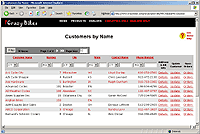
To try it out: Go to this application and look for the “Customer Name” column.

You'll notice there's a field to enter information. The dropdown next to it is marked CT. (CT stands for Contains, so when you select CT from the drop down, you are looking for Customer Names that "contain" the letter, word or number you are searching for.)

To use it, let's say you are using this application to look for customers with the word “bikes” contained in their names. To use mrc Prompt, type the word “bikes” one letter at a time. As each letter is entered, a drop down will appear showing you only those options that contain the word bikes. You can then click on your selection and hit enter to bring up your record of choice.

Give it a try in each of these fields. It's an amazing way to drill down to filter information on the fly.

Tuesday, December 26, 2006

Web Design Tip #15: Creating ordered lists

As a follow up to last week's article on creating Web content through use of bulleted lists, there are also some built in list building features which allow you to create ordered lists.

Ordered lists can come in handy in a number of ways on Web sites, or Web applications, but probably find their most common use when developing a series of ordered steps or instructions.

This article tells you how.

Wednesday, December 20, 2006

Personalize your Google Page..with Cup of Joe!

If you have already personalized your Google search page, you can add this blog feed to it and see our latest posts as they are updated! Just click the "Add to Google" button on the top of the right hand column of this page.

If you haven't personalized your Google search page yet, here's how to do it:
1) Create a Google Account.

2) Once your google account is completed and you're signed in, go to http://www.google.com and either click on the "Personalized Home" link in the upper-right corner of the page, or you are already at your personalized home page.

3) Now, come back to this blog, and look at the right column, and click on the brand new button we've added right above the search window that reads, "Add to Google!" Then, click "Add to Google Homepage" button.

Monday, December 18, 2006

Web Design Tip #14: Creating bulleted lists for better organization

Real estate on Web sites is limited, so it often comes in handy to give users easier ways to find and break down information more quickly.

One of the simplest solutions is to create simple lists using bullets.

Here's how you can create your own»

Friday, December 15, 2006

Another great idea to steal

Information Week recently compiled a list of the top 20 IT business ideas (that you might want to steal.)

Inventory Master
E.&J. Gallo Winery developed a warehouse management & logistics system, giving managers inventory and supply chain visibility in distribution centers worldwide.

The system uses RFID with automated vehicles inside Gallo warehouses. That, with data integration among planning, sales, and delivery systems resulted in: 35% improvement in demand forecast accuracy, 98.5% inventory accuracy. The order-to-ship cycle is half what it was--and all while the winery's brand portfolio doubled.

This kind of integrated information sharing and forecast accuracy can be even more challenging when there are many systems and databases involved. Here's one manufacturer who had to track production on products that were being created in four worldwide plants...and had "made do" with an e-mailed Excel spreadsheet for a little too long.

Thursday, December 14, 2006

Happy Holidays from all of us at mrc!

Click on the image below and build your own snowman!

Friday, December 08, 2006

This is not your father’s report-writer! (The Remix)

The Web world has not only given new life to business intelligence, but to everyday report-writing.

Web reports can contain links and graphics to product and customer information and let you drill around your data, resulting in more information at your fingertips, and in a much more readable format. And...it's all done in an instant.

Try it! This one lets your user request a report via the internet, run it and distribute it automatically via email, or run it on the fly. It also lets you determine the data and formats...PDF, XML, CSV, HTML, whatever you like.

Thursday, December 07, 2006

Older IT Workers: The survival guide

The ever-changing nature of tech means there’s a kind of ageism built into the industry itself. Previous experience is devalued because previous technology moves toward irrelevance.

Couple this built-in ageism with an employers concern about job longevity, and veteran IT staffers can face a real challenge: how can I stay employed after the first few gray hairs?

This article has some hints»

Wednesday, November 29, 2006

Executive Dashboards...not just for executives anymore?

One of the longest-running complaints of BI is that companies have the capabilities to analyze the data, but often there is so much of it that pertinent critical data gets overlooked, or is outdated by the time it gets into the hands of the people who need it.

Not true if the BI application is done right. Take advantage of the Web and smart technologies in a dashboard like this one to give your people the best chance to make the information work for you.

Tuesday, November 28, 2006

First of twenty great business ideas you should steal...

Information Week recently compiled a list of the top 20 business ideas (that you might want to steal for your very own.)

Here's the first:
"Construction company Emcor Group put voice, e-mail, and specialized applications on a handheld device that fits in a shirt pocket. That's providing a practical way to keep the people closest to the customer up to date.

Field technicians are now more productive, using a wireless dispatching system tied to Emcor's customer support center. The same device used by the technicians for this service application is also their cell phone. The approach has improved time to invoice, invoice accuracy, and overall customer satisfaction by more closely integrating the field to the office."

You can create an application just like this»

Friday, November 24, 2006

iSeries Devcon recap: 8:30 am in Vegas is simply unnatural

For those of you that attended our lab at iSeries Devcon, thank you! It was great to get your perspective on the tools, and we really enjoyed meeting all of you. Remember, if you have any questions, don't hesitate to let us know!

If you weren't at Devcon, or you just felt that 8:30 am in Vegas was a cruel cruel joke...we feel for you.

That's why we've decided to offer the hands-on Web development seminar you missed at Devcon in this handy online lab! (You'll build two Java Web apps in half an hour!)

Tuesday, November 21, 2006

Sci-Fi Cool Gadgets-- Closer to fact than fiction

Science fiction writers, have in the past acted as "technology seers" and have predicted such breakthroughs as flight, cyberspace and computer viruses among other changes.

Here's a few future-gadgets on the horizon that might interest CIOs in particular.

Monday, November 20, 2006

Biz App Tip#4: Watch out for outmoded meta-languages

As technology behind business applications and BI has evolved...there has been a rebirth of big-picture thinking, giving companies reason to re-evaluate their BI software choices and application development tools.

One of the biggest changes has been a calculated move away from outmoded meta-languages. But, unfortunately, many tools out there still incorporate them.

Here's what we mean by meta-languages, and why should do your best to avoid them»

Friday, November 17, 2006

The Great Mashed Potato Experiment of 2006

In the spirit of Thanksgiving, mrc's Marketing Director talks about her lifelong love of mashed potatoes, and offers the results of her great Mashed Potato Experiment of 2006...and what she learned.

Learn what she learned, and get her mashed potato recipe here»

Wednesday, November 15, 2006

Top 10 project problems to avoid

Take these cautionary tales to heart, so that you can sidestep these pitfalls in your own business.

Friday, November 10, 2006

Business lessons: Take four steps toward data security

We don't talk a lot about data security in this blog usually, unless we are touting our own security features (of which there are many).

However, there are definitely areas of improvement that every company can examine to ensure that private information is secure, corporate secrets are guarded, and internal applications find the the right balance between protection and accessibility.

Here are four steps you can begin to take to improve data security at your company.

Wednesday, November 08, 2006

Smartphones: What to look for, and what you can do with them

What's a smartphone? Well, where BlackBerry made its mark by providing email to the road warrior, this new generation shoots for not having to carry a laptop at all.

This great InformationWeek article gives you a side by side comparison of what the best SmartPhones to bet on are.

And this new quick case scenario from Emhart Glass gives you a good example of some of the cool applications you can build for them.

Monday, November 06, 2006

Business App Tip #3: Use an Easy Dashboard Speedometer

With the rise in popularity of both executive dashboards and portals, and the demand for instant BI, one of the easiest to read tools you can use is the dashboard "speedometer."

With one quick glance, a manager can grasp what is really going on in her business, be warned of new problems and react quickly.

We use our speedometer capabilities in our internal dashboard to track how our help desk is doing, whether we are answering our customer needs quickly enough. If you'd like to use this metric monitor in your dashboard, this short article tells you how.

Sunday, November 05, 2006

3 minute learning: AJAX

This week's 2 minute mPowerPod sheds light on AJAX...which is why it's actually more like 3 minutes this time around.

Find out what all this talk of AJAX is, where it can benefit you, and how you can use it in this short and sweet 3 minute podcast.

(You don't have to have an iPod to take advantage of these mPowerPods.)

Friday, November 03, 2006

Top 12 Tech Metrics to Gauge Business Impact

This Information Week article, talks about the challenge CIOs face in measuring the value of IT with traditional ROI or TCO (total cost of ownership) metrics.

Instead, they are being asked to track specific business needs. Here's what they say are the Top 12 tech metrics you need to keep your eye on.

Monday, October 30, 2006

Boo! Happy Halloween: 25 IT Horror Stories

In the spirit of Halloween, here's an article from CIO magazine on their top 25 IT horror stories, and if it doesn't serve to frighten, it might serve to offer some cautionary tales...

(oh...and you might want to turn on your speakers...)

CIO Magazine: 25 IT Horror Stories

Friday, October 20, 2006

Business App Tip #2: Incorporate outside technologies to strengthen your apps

We're always talking about the importance of flexibility, but we're usually talking about platform or database flexibility and how you can access any database or create apps to run on any operating system (or systems) you choose.

But another area that you should pay attention to is also an "internal flexibility" or the ability to pull in outside technologies and resources to further extend your application capabilities with the latest and greatest capabilities.

Here's a quick article on some of the benefits.

Thursday, October 19, 2006

Penny for your thoughts? How about a Harvard white paper?

We really appreciate your thoughts and insights. It help us keep our blog posts, articles, and newlsetters relevant to you. So, we'd really appreciate your help once again, and we're not above bribery...ahem...I mean, incentives.

If you fill out this quick survey, we'll forward you this helpful white paper from the Harvard Business School: Why IT matters in mid-size companies, exploring how IT capability is the key to profitable business growth.

Wednesday, October 18, 2006

Are Enterprise Apps on the way out?

Apparently, at least according to this article from CIO Magazine, IT execs feel that most business functions can benefit from automation, but data integration problems must first be solved. That means stepping toward SOA and Web services—and away from suites like CRM and ERP.

However, that task needn't be daunting, or all at once..

You can integrate data from disparate sources by either creating custom applications that access multiple databases, or by copying data from one database to another, and when they are built with the right architecture, moving them over to SOA and Web services is a simple next step, rather than an enterprise-wide ordeal.

Friday, October 13, 2006

2 minute power learning: mPowerPod meets Open Template Technology

This week's 2 minute mPowerPod sheds light on Open Template Technology.

Find out what Open Template Technology is, where it can benefit you, and where to find it in this short and sweet two-minute podcast.

Friday, October 06, 2006

Introducing 2 minutes of power learning...the m-Powerpod.

What is the m-PowerPod, you ask?

Well, it's a podcast designed to provide fact-filled tidbits on technology, web applications, special features, and business benefits...all in under two minutes.

This first mPowerPod is the definitive mPowerPod intro of who we are and what we do...and also gives you an idea of how quick these mPowerPod's really are!

Tuesday, October 03, 2006

10 commandments of project management

Project management is always a challenge in one way or another, but there are ways to smooth your path.

By following these 10 commandments from ComputerWorld, you will have a much better chance of being successful in the long term.

Monday, October 02, 2006

Web Tip #9: How cascading style sheets work

Not totally familiar with cascading style sheets? Here are the basics...

Cascading style sheets are the best way to get (and retain) a professional look for your Web site, and also the easiest way to apply and maintain that look on the pages throughout your site.

Here's a quick look at the elements involved.

Thursday, September 28, 2006

Three big business problems with two commonalities. Can you name them?

Company #1: found a reporting solution that fit all of their criteria, over and above the usual players.

Company #2: created a series of wireless applications to allow their floor workers to quickly gain access to the information they needed from their blackberries.

Company #3: built a custom shopping cart application, like this one that was actually less expensive (and took less time to implement) than the packaged solutions they were considering.

So? What do these three have in common?

Wednesday, September 27, 2006

Aligning your CIOs and COOs to be more productive

With the advent of IT roles focusing more on executing business strategy, managing operations, and exploiting opportunities, there comes some growing pains.

CIOs and COOs often find themselves in overlapping roles, which can be counterproductive.

Here's what you can do to better align the roles»

Monday, September 25, 2006

Unique use of RFID data changes the face of new product sales

We don't often cover RFID (Radio Frequency Identification) best practices in this blog, mainly because although many clients use RFID, mrc's tools are more often used to analyze the BI data the method provides.

But, I also enjoy looking at new ways that technology can be used. Here's how one manufacturer used RFID to not only track their product, but also to measure whether it got promoted properly--and what they found out they needed to do.

Thursday, September 21, 2006

Easily take advantage of drop downs in your mrc reports.

Drop down menus can be a great way to quickly narrow down the data in your reports to the data sets that you seek, and allow you to provide even more end-user friendly (and flexible) reporting options--freeing up IT time.

And, the newest changest to m-Power, particularly the inclusion of the m-Painter feature, make including dropdowns in reports a breeze.

Here's one how-to article posted in the user forum that gives you some tips on how you can get you started.

Wednesday, September 20, 2006

Four Business-IT Pitfalls to avoid

Here are four Business-IT pitfalls that cause IT projects to fail. Keep them by your desk, and remind yourself of some of the talking points you should bring to the table the next time you are called to a meeting.

Nipping these pitfalls in the bud, and finding a good dialogue in the process, may help you avoid many of these bumps in the road.

Friday, September 15, 2006

SOA in plain language.

SOA. Service Oriented Architecture.

The name says it all. Well...kind of. Hmm...not really. What service? It's an acronym defined by buzzwords.
And it might surprise you to learn that it is related to, but separate from, Web services...which it is sometimes lumped in with.

This article from Datamation breaks it down in plain language. Finally!

Tuesday, September 12, 2006

Web 2.0 and what it will mean to BI

If there's one thing technology marketers are really good at, it's complicating matters by coming up with new buzzwords to describe basic concepts...for example: Web 2.0.

What the heck IS that? And why have I never heard of Web 1.0?

In this article, you'll get a good read on how Web 2.0 is defined and how you can begin applying its basic tenets to your business intelligence.

Thursday, September 07, 2006

10 steps to save a foundering project

We've all been there at one point or another. A project that started out strong suddenly takes a turn, and you are faced with a decision. Salvage it, or scrap it.

So, when you find yourself in this predicament--what do you do?

This Computerworld article has some great information to help you evaluate and make that call: Sink or Swim?

Monday, September 04, 2006

Web Design Tip #7: Choosing a color scheme based on images

A few weeks ago we gave you a basic guide to selecting Web colors, specifically hexadecimal colors, and how to use them in your Web designs.

Another consideration for selecting a color scheme for Web pages is by selecting colors that complement the images that you are using. Here's how»

Thursday, August 31, 2006

Product shots in B2B Web apps improve bottom line.

Including product images in e-commerce ordering apps and shopping carts ensures that the correct product is being ordered, and prevents click-errors and order-entry typos. This saves businesses a ton of money on returns, delivery delays, and manufacturing production delays.

For example, here's the new online order interface recently added to crazybikes.com Note: as you order, the images appear in your cart, allowing you to prevent any mistakes.

Monday, August 28, 2006

Creating Extra Functionality in mrc Calendar Template

You've probably seen samples of mrc's calendar template in action, and as an mrc customer, you may have one of your own...but does it have all of the functionality you need?

Well, now it's easy to include additional functions in your calendar such as search capabilities and drop down menus. Here's how»

Friday, August 25, 2006

Seven Pillars of BI Success

Whether you get your business information via a dashboard, portal, or some other interface, the BI tool has become the primary domain of IT's most important constituents: end-users.

This Intelligent Enterprise article takes you through the seven "pillars," or best practices that support the most successful BI implementations, and where you should direct your focus to start achieving BI success and solid business alignment.

Thursday, August 24, 2006

Pop Quiz: Crazybikes.com: which design changes are most important, and why?

We recently put crazybikes.com through a major design overhaul. Why? Well, we've been doing quite a bit of talking recently on corporate branding, and what is important when establishing a look for your Web site...and that got us thinking. Where did this site need to improve?

So you tell us...

Pop Quiz: Which design changes are most important to the site, and why?

Monday, August 21, 2006

Using AJAX techology for better functionality and easier navigation

As an mrc customer, here is one perk courtesy of AJAX technology that can make your Web application navigation super easy. Here's what I mean: Go to this application and click on one of the customer name links. Now, do you see the tabs that appear at the bottom?

Note that each tab correlates to a different application, but the data that appears is only to the record selected. You never have to leave the Web page.

Here's how to include it in your application»

Friday, August 18, 2006

Preparing your laptop for airport security.

This article from Information Week gives some useful tips for business travelers, particularly those traveling to and from the UK with the latest security restrictions.

Friday, August 11, 2006

What's the right Web "combo platter" for your business?

Listen to this brand new (and very quick) podcast on the three main Web venues available to your business, some potential areas where you could benefit in each, and what to consider when determining which combination will help your business get the most out of the Internet.

Thursday, August 10, 2006

Color code your data to see things at a glance.

An easy way to do this is by using Conditional Calculations (Calcs) in m-Power applications.

mrc's conditional calcs also allow you to customize customer views/available links based on log-ins, allow users to update/add/delete a record depending on the value of a specific field, and color code your data for easy analysis.

Here's how you can take advantage of this feature»

Wednesday, August 09, 2006

Diagnose and treat IT-client relationship breakdown before the break-up.

Although not a new issue, the breakdown of working relations between IT departments and their internal clients appears to be getting not only more common, but also more serious. Almost every organization has at least some of the symptoms. What are yours?

This article from Darwin Magazine helps you put an end to the finger-pointing and breakdowns, and vaccinate, diagnose, and cure these common ailments.

Friday, August 04, 2006

Executive Brief: Improve business/IT alignment.

As a sidebar to an article on the drive for better Structured IT Management, this quick article from Intelligent Enterprise, delivers on one of our favorite topics: How to Turn IT Resources Toward Strategic Business Advantage.

Its tips include: improving business agility, getting out of reactive mode, and using tools to improve IT executives' business understanding.

Thursday, August 03, 2006

New look to Web site targets an easier way to find the information you need.

You may have noticed that we've updated our site again to give you an easier way to find the information you seek.

Now you can begin navigating the site starting with topics that are near and dear to your position. You get what you need»

Friday, July 28, 2006

Announcing mrc's new customer portal

mrc's newly re-designed Customer portal was created using m-Power and has more of a dashboard feel. Here's what you can do with it:


Wednesday, July 26, 2006

Reactive to proactive: How to escape the 80-20 Rut

This article in Computerworld, "Escape the 80-20 Rut" is a great little follow up to the white paper we discussed last week about determining the value of your IT projects.

This article gives you some other ideas on how to save by creating a consolidation strategy, and as they put it: "The goal is to free up dollars and personnel from maintenance and management tasks and create an infrastructure flexible enough to react to business changes and problems."

Monday, July 24, 2006

The secret to finding the Value of IT might all be in where you look.

In a recent poll by CIO Insight, 94% of IT executives at companies that don't measure any ROI say that it's because it's too difficult to calculate.

But perhaps we're making it too complicated. Here are some quick and dirty measurements you can pull together to create a better understanding of the value of your IT projects.

This article by one independent IT research firm gives you the high points to predicting ROI to help establish the value of your IT initiatives:
Measuring your Return on Investment: Quick Reference Guide»

And here's one of ours, containing a lot of good general information about where to find value in Web initiatives Determining the Value of Delivering Web initiatives with m-Power»

Wednesday, July 19, 2006

What SQL Server Magazine has to say about m-Power

Have you seen the recent blurb on mrc in July's edition of SQL Server Magazine?

It talks about how m-Power has helped solve the universal problem: how to get business intelligence to users in the form they need it...when they need it.

Read it here»

Thursday, July 13, 2006

Cool Web Typography Tool you should know about

After your crash course last week on the basics of Web Typography, here's a free, and easy-to-use tool to help you pick and choose the look of the text on your Web site.

The tool, called Typetester is used via the Web, and it will help you to drive home that Typography knowledge you picked up in last week's article.

A link to the tool, and some quick pointers on how to use it, is located in this new Forum post.

Wednesday, July 12, 2006

The future of e-mail

Technologies emerging from R&D labs will make e-mail more productive and give it new roles in the next few years.

This article gives insights from industry experts about what we can expect from email in the future.

  © Blogger template 'Isolation' by Ourblogtemplates.com 2008

Back to TOP