Friday, February 23, 2007

Web 2.0 transcends hype for business

You may not be ready to embrace concepts like "social computing" or "participative computing" in your organization, but the benefits of Web 2.0 can no longer be ignored. In fact, Web 2.0 figures prominently in Gartner's latest list of key actions IT leaders should take over the next three years to demonstrate value to their organizations. This article from 1105 Media gives you the 411. Read more»

Thursday, February 22, 2007

Trend to watch: Manufacturing Job One: Improve information flow.

In a recent article published by Intelligent Enterprise on the Top Seven Trends to watch, one to focus on is found in Manufacturing's inherent need to improve information flow.

Manufacturing executives realize that if they can solve the problem of gathering information from their company's portfolio of data sources in the plant or value chain--and build that capability into a linked enterprise process--they will have a considerable competitive advantage. Here are some examples of what we mean»

Monday, February 19, 2007

Magically turn Excel pivot tables into Web reports.

Every day end-users across the globe spend a large amount of time pulling data into spreadsheet programs like Excel, and then using pivot tables and the like to analyze data. This wastes a lot of time, is insecure, inefficient, and often inaccurate.

But, there's a new way you can help your end-users save time, do away with security issues, AND create their own Web reports. Here's a short presentation on how»

Wednesday, February 14, 2007

What SaaS (Software as a Service) means for you

What is SaaS? Here's the simplest way to think of it: "The Web has become a solid application delivery platform, transforming the way we can deploy enterprise software." This CIO Magazine article gives you a better picture, AND names it as one of the top 5 major IT changes that you need to consider.

Whatever you choose to call it, it all amounts to becoming more flexible and nimble and saving money by not having to write code from the ground up for each application. Here's one manufacturer's story on how they created an enterprise-level executive dashboard tied to their enterprise software package...without having to write it from scratch.

Monday, February 12, 2007

Calling all System i Innovators

Individuals and organizations that have discovered innovative ways to utilize their System i platform are in luck.

Now is the time to nominate someone—perhaps yourself--perhaps your favorite Tool Vendor (hint, hint)—for one of the IBM System i Innovation Awards. The nomination deadline for the 2007 awards is end of day on Wednesday, February 28, 2007.

You've worked hard on your system designs, and development. Start reaping the rewards!

Check out the details here»

Friday, February 09, 2007

Dear Marcy, What's the deal with AJAX?

Dear Marcy,

I keep hearing about AJAX, but I don't really have a grasp on what it's all about, or why it would be helpful for a company like mine? (We're strictly B2B.) Could you give me a basic understanding in a nutshell, of why I should be interested in it?

--Curious in Canada


Here's her response»

Thursday, February 08, 2007

Trend to watch: Business Analysts Step Up and Design for Agility

There are new factors changing not only Business/IT alignment, but also the role of the business analyst. This shift puts the business analyst in the role of application planning, and design in many cases--without any specific IT implementation required of them.

This renewed focus on "What is Needed" rather than "How it is built" is a paradigm shift similar to the IT equivalent of what manufacturers did to enable themselves to construct product simulations before ever cutting a single piece of material.

Here's a quick article that takes a look at the ins and outs of the Business Analysts changing role.

Tuesday, February 06, 2007

Curious about how PHP stacks up to Java?

You've probably been hearing a lot about PHP of late, but what's not so clear is how it stacks up against other languages like Java, and when it is best used.

This article (sign in as ID/password marcy/marcy) says this: "So how does PHP fare against Java? It depends on the application. If it's an enterprise application that requires integration with multiple applications, languages, and databases, Java or .NET beat out PHP."

PHP is easy to learn, and easy to use to create basic dynamic Web applications, but the article offers this caveat: "But the more sophisticated your PHP applications become, the more it makes sense to use Java."

(The nice thing is, using m-Power to develop those complex Java apps is even faster than using and executing simple PHP.) Try it out here»

Thursday, February 01, 2007

Dear Marcy, Your competitors tell me they access multiple databases too, so what is the big deal?

Dear Marcy,
I’ve been looking at application development tools that can access multiple databases (I need to access SQL Server and Oracle 10g along with DB2). mrc is always talking about how m-Power can access any database, but I’ve been talking to two of your competitors and they both say their products do the same thing.

I don’t see why this is the topic of so much discussion if it’s something everyone else does too. --Comparing Apples to Apples?


Here's her response»

Wednesday, January 31, 2007

Web Design Tip: Use an HTML checker

When your site has HTML errors, missing links, spelling mistakes and browser-compatibility problems, your site is losing its effectiveness.
Luckily, there are tools out there to let you double-check your work and rid yourself of some of these common problems.

This short article tells you about one tool that offers a free trial that works so great...well, we'll let you decide.

Tuesday, January 30, 2007

Trend to watch: Improving on processor speed.

This article, from Intelligent Enterprise magazine, in the section titled, "Computing at a Crossroads" talks about how despite rapid performance growth between 1986 and 2002, nearly doubling performance and power almost every 18 months, microprocessor companies in 2004 hit a "Power Wall," and what it will mean to programmers going forward. The ball is now in their court.

Programmers will need to learn to architect applications that most advantageously take advantage of these processors using techniques such as "paralleling" and multi-threading, in order to gain the best performance from their applications, to improve performance per watt, or performance per dollar within the peak performance of the microprocessor.

With the advent of mrc's new Web 2.X templates, these considerations are already built in, creating systems of multi-threading for the best scalability and to use the processor most efficiently.

Smartphones and you: Running BI from your mobile device.

With the new introduction of Apple's iPhone, SmartPhones are in the spotlight once again.

Here's a great side-by-side comparison of what to look for from your SmartPhone operating systems.

And remember, while you can offer Linux-based applications on the phone itself, providing browser-based applications may be faster and more secure. After all, if everything is through a browser, if you lose your phone, the only thing you lose...is the phone.

Tuesday, January 23, 2007

Portals and Portlets: What they are, and what they do.

Portals and portlets are terms often bantered about and can be very powerful business tools, but what do you need to do to create them, and what makes them different from other Web applications?

Here is a new straightforward overview of portals and portlets and what they can mean for your business.

Monday, January 22, 2007

Web Design Tip: Hex colors and how to use them.

When designing a Web page in HTML, colors are defined using a 6-figure coding system called hexadecimal(or hex) colors .

For example, if you wanted to make some text red, you could type: <font color="#FF0000">This is a hexadecimal code for red</font> into your HTML, and your Web page would show this: This is a hexadecimal code for red.

But where do these 6-figure codes come from, and how can you determine which colors will work for your site?

Here's a quick article to give you the background along with some tools you can use to make color selection easier.

Friday, January 19, 2007

Dear Marcy, I can't tell if shopping cart is tied to a larger system, or if it's just a demo application.

Dear Marcy,
We are in the process of researching how to develop a shopping cart/order entry system for our customers. We've run across a variety of options in the process. One way requires us to copy data over from our backend system to an MS-based server (to provide an extra layer of security), and have the MS guys create the application from there. But, I've been arguing with management that this is inefficient, and also dangerous in its own right because of data inaccuracies.

The other option we've been looking at is a plug-in module manufactured by our MRP vendor.

I know crazybikes has a shopping cart. But, I can't figure out from your site whether it's tied to a larger complex backend system, or if it's just a stand-alone demo application that was hand-coded. What is it written over and/or is it possible to write it over my MRP (we use Movex)? If so, how much would something like that cost? Would we need a consultant? --Exploring Options


See her response here»

Wednesday, January 17, 2007

Attend the Omni User Group Conference for DB2/400 users in Chicago

It will include a brand new mrc hands-on lab (with new Web 2.X features) and industry experts speaking on various modern business and IT solutions. For more information, visit our events page.

Or, if you would like to try our original hands-on lab online instead, you can do that right now if you like! Just sign up here. (It takes less than 1/2 an hour to develop 2 Java applications!)

Monday, January 08, 2007

Study: Most managers' info searches are useless

A newly released study from Accenture says most managers' info searches are useless, and that more than half the data they find has no value to them.

Here are a few interesting statistics:

  • Only 16% store valuable data in a collaborative workspace like a portal.
  • Over 42% said they accidentally use the wrong information at least once a week.
  • 57% said having to go to numerous sources to collect data makes managing it difficult. On average, the managers said they go to three different sources to find certain types of information.

Creating a portal like this one (Sign in as 10DKS10 as both user and password to view it) solves many of these problems and can be accomplished very quickly and cost-effectively.

Friday, January 05, 2007

Web Design Tip: Including Icon in URL

You may have noticed that often next to the URL in your browser, or in your favorites folder, companies have placed their logo or a corporate icon of some kind.

For example:


If you would like to do the same for your Web site, it's easy. We've posted an easy how-to article on the User Development Forum. You can find it here»

Friday, December 29, 2006

Dear Marcy: How can I convince management that the platform I know is the platform to keep?

Welcome to our latest forum feature: "Dear Marcy" where you can write in anonymously and ask our resident expert business and IT questions that you might like some creative solutions to.

Here's the first published letter:

Dear Marcy,

My company just got acquired by a larger company, and they are running their business applications on SQL Server. We run ours on DB2 served off an iSeries.

This concerns me because I’ve got expertise associated with the AS/400 or iSeries platform and don’t want to be downsized.

How can I try to convince management that the iSeries is the one to keep?

Sincerely,
Acquired in Alabama


Read her response here»

Or, you can listen to this podcast response, if you'd rather not join the forum.

Wednesday, December 27, 2006

Web 2.0 capability: AJAX in action

Here's one example of AJAX in action that makes it faster and easier for your users to get to the critical information they need.

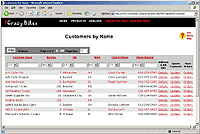
To try it out: Go to this application and look for the “Customer Name” column.

You'll notice there's a field to enter information. The dropdown next to it is marked CT. (CT stands for Contains, so when you select CT from the drop down, you are looking for Customer Names that "contain" the letter, word or number you are searching for.)

To use it, let's say you are using this application to look for customers with the word “bikes” contained in their names. To use mrc Prompt, type the word “bikes” one letter at a time. As each letter is entered, a drop down will appear showing you only those options that contain the word bikes. You can then click on your selection and hit enter to bring up your record of choice.

Give it a try in each of these fields. It's an amazing way to drill down to filter information on the fly.

  © Blogger template 'Isolation' by Ourblogtemplates.com 2008

Back to TOP